Angioplasty and stents
Coronary angioplasty widens a narrowed heart artery from the inside using a small balloon, and a stent, a fine metal mesh tube, helps keep it open.
Read the guideA coronary angiogram is an X-ray test that shows the arteries that supply the heart. A thin tube is passed, often from the wrist, and a contrast dye makes any narrowing visible. Dr Shady Habboush performs coronary angiography at Saudi German Hospital Dubai and explains the findings with you.
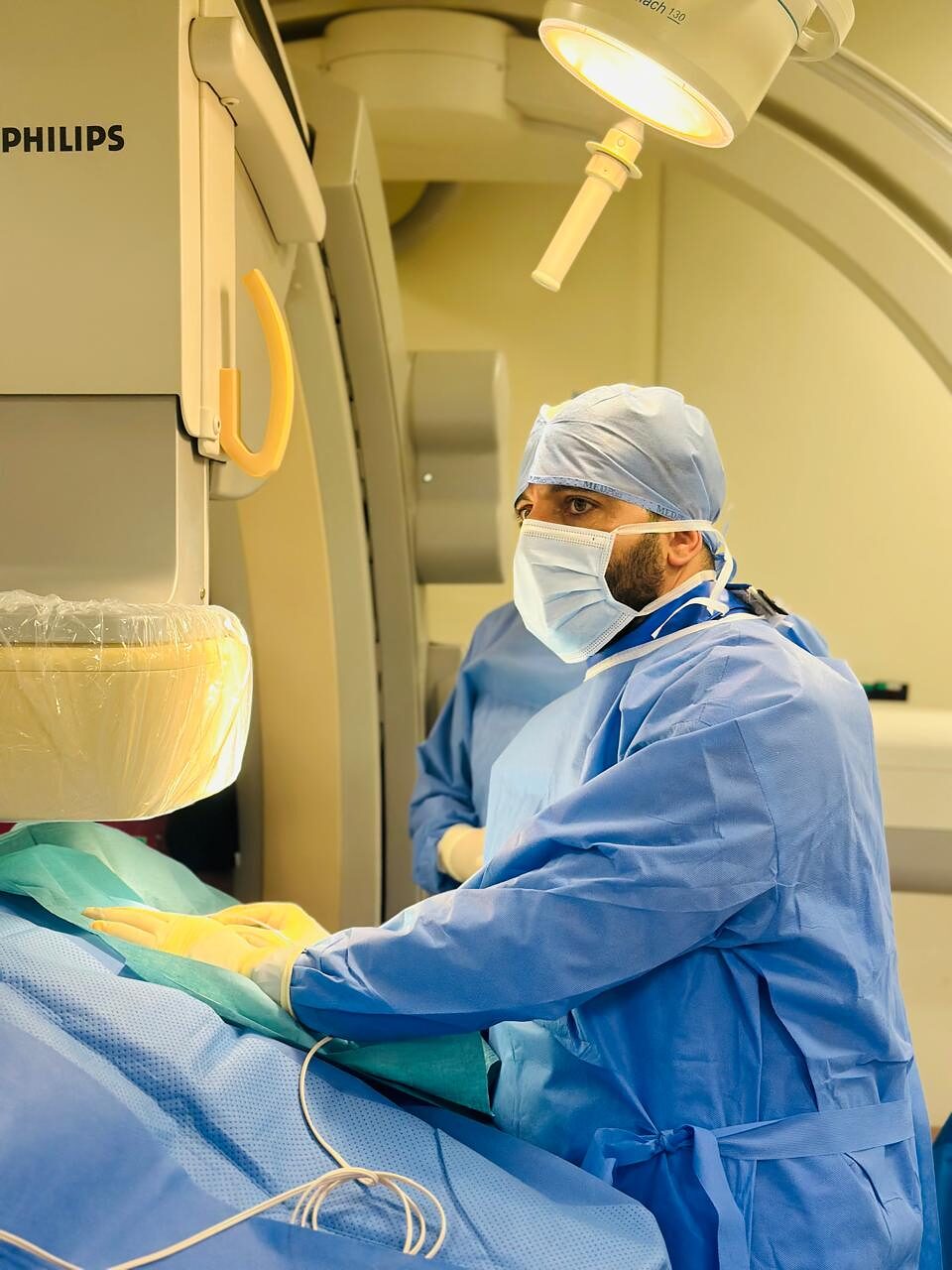
Coronary angiography is a common test, but it has risks, including bleeding or bruising at the puncture site, reaction to the contrast dye, strain on the kidneys from the dye and, rarely, damage to an artery, stroke or heart attack. Alternatives such as a CT coronary angiogram or a stress test may suit some people. Benefits, risks and alternatives are discussed with you before you decide.
You are usually asked not to eat for a few hours before. The hospital gives you exact instructions when the test is booked.
The skin at the wrist (radial artery) or the groin (femoral artery) is numbed with local anaesthetic. You stay awake, and a mild sedative may be offered.
A thin, flexible tube (catheter) is guided to the heart arteries under X-ray. You do not feel it moving inside the arteries.
Contrast dye is injected and X-ray images are recorded. Some people feel a brief warm flush.
If a significant narrowing is found, it can sometimes be treated in the same session with a balloon and stent, if this was discussed and agreed with you beforehand.
The tube is removed and a pressure band or dressing closes the puncture site.
The test itself often takes about 30 minutes to an hour, and longer if a stent is placed. Many people go home the same day after a few hours of rest, though this depends on your situation and whether a stent was placed.
The wrist or groin can feel sore or bruised for a few days. You will be told how long to avoid heavy lifting and when you can drive again.
Dr Shady goes through the pictures with you and explains what they mean for your treatment: medicines, a stent, or referral for coronary bypass surgery.
Often from the wrist (radial artery). The groin is used when the wrist route is not suitable. The route is chosen for each patient.
Usually for a few hours before. The hospital gives exact instructions, including which of your usual medicines to take, when the test is booked.
Yes. The area is numbed with local anaesthetic, and you can talk to the team throughout. A mild sedative may be offered.
A CT coronary angiogram uses a scanner and an injection into a vein. An invasive angiogram uses a catheter and gives more detailed pictures, and a narrowing can sometimes be treated at the same time.
Not necessarily. Many angiograms show arteries that are normal or need medicines only. A stent is considered only if a narrowing is significant and the benefits outweigh the risks for you.
Coronary angioplasty widens a narrowed heart artery from the inside using a small balloon, and a stent, a fine metal mesh tube, helps keep it open.
Read the guideIntravascular ultrasound (IVUS) uses a tiny ultrasound probe on a catheter to image a heart artery from the inside.
Read the guideCoronary artery disease is narrowing of the heart's arteries by fatty plaque.
Read the guideMedical facts on this page follow the sources below.
Medically reviewed against ESC and NHS guidance · Updated October 2026. General information, not medical advice.
Appointments are made through Saudi German Hospital Dubai, Hessa Street, Al Barsha 3. Consultations in Arabic, English and German.
Chest pain right now? Do not wait for an appointment. Call 998 or go to the nearest emergency department.